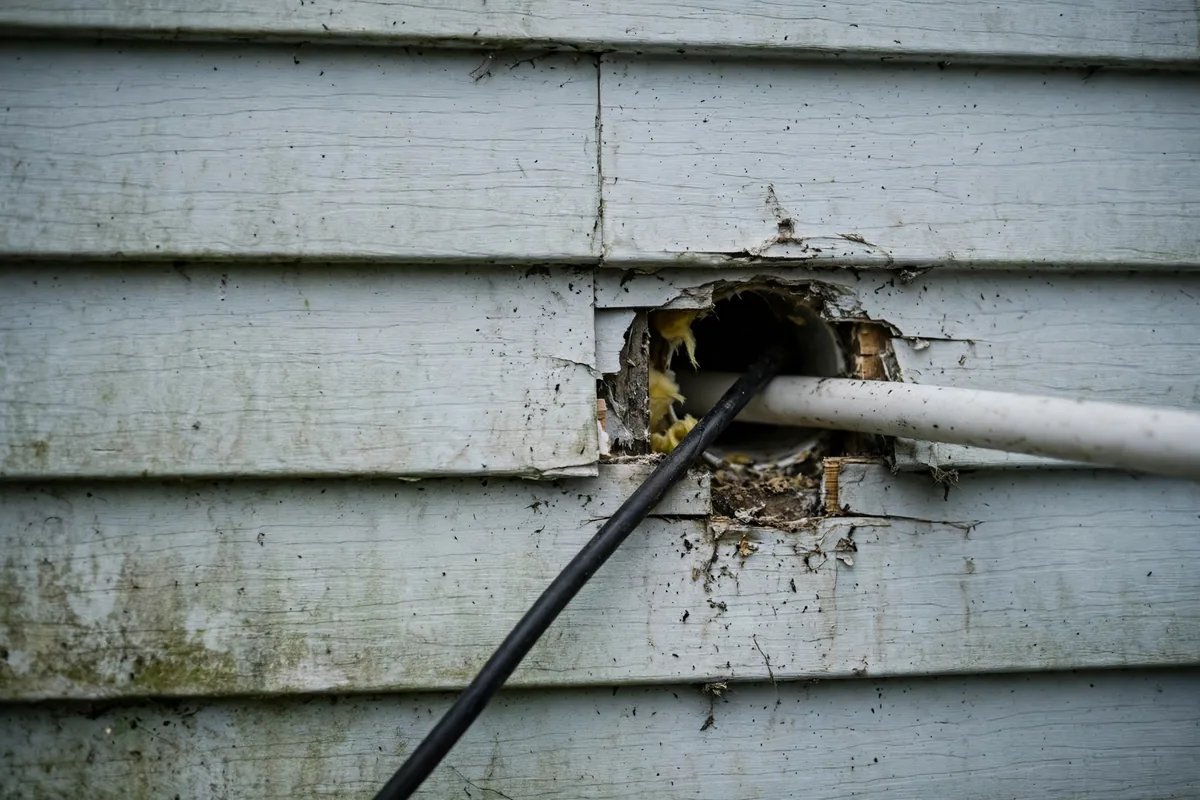
- A house mouse fits through a gap about a quarter inch wide, roughly the width of a pencil
- The entry points that matter most are utility penetrations, garage door corners, and the gap where siding meets the foundation
- Steel wool and copper mesh work because mice cannot chew through them; expanding foam alone does not
- Trapping without sealing is an endless job, since the opening that let the first one in is still open
- Mice breed year round indoors, so a small October problem is a large February problem
The Quarter-Inch Rule
This is the number worth remembering. An adult house mouse can get through an opening about a quarter inch across. Their skull is the limiting factor and it is narrower than people assume, and the rest of the body follows wherever the head fits. A young mouse needs even less.
Practically, that means if you can slide a pencil into a gap, a mouse can use it. Most homeowners walk their foundation looking for holes and miss everything because they are scanning for something mouse-sized instead of pencil-sized.
Mice are also better climbers than their reputation suggests. They handle brick, siding, downspouts and stucco without much trouble, so entry points six feet off the ground count just as much as the ones at grade.
Where They Actually Get In
In the houses we look at around Monmouth County, the same handful of spots come up over and over:
- Utility penetrations. Wherever a pipe, wire, cable line, AC line set or dryer vent passes through the wall, there is usually a gap around it. This is the single most common entry point and the one people never check, because it looks finished.
- The garage door. Specifically the bottom corners, where the weather seal curves and leaves a triangular gap on each side. Walk out and look at your closed garage door from the outside at night with a light behind it.
- Where siding meets the foundation. That seam often has a continuous gap behind the starter strip.
- Crawl space and basement vents with damaged or missing screening.
- Soffit and roofline gaps, especially where a lower roof meets a wall.
- Under exterior doors with worn thresholds or sweeps. If you can see daylight, that is an open door.
What to Seal With, and What Not To
Material matters here more than effort. Mice chew, and they chew specifically to enlarge an opening they can already smell air moving through.
- Copper mesh or coarse steel wool stuffed into the gap, then sealed over. They cannot chew through it, the strands catch their teeth. Copper mesh is better than steel wool because it will not rust and stain your siding.
- Hardware cloth for larger openings like vents and crawl space access. Use quarter inch, not the half inch stuff, which mice walk right through.
- Metal flashing or sheet metal for long gaps at the foundation line.
- Caulk or expanding foam over the top to seal air and moisture. By itself foam is useless, mice tunnel through it in an afternoon. As a cover over mesh it is fine.
Skip the folk remedies. Peppermint oil, dryer sheets, and ultrasonic plug-ins have no meaningful effect on a mouse that has found a warm place with food. The only thing that reliably stops a mouse is a gap it cannot get through.
Why Trapping Alone Never Ends
This is the part that frustrates people. You set traps, you catch six mice, you feel like you are winning, and two weeks later there are more. Nothing went wrong. The opening that let the first group in is still open, and the territory you just cleared is now vacant and attractive.
Trapping is how you handle the mice already inside. Sealing is how you stop the supply. Doing the first without the second is a subscription, not a solution.
The urgency is about math. Mice do not have a breeding season indoors. In a heated house with access to food, a pair can produce a new litter every three weeks or so, and those offspring mature in a couple of months. The handful that get in during late October are why people call in February wondering how it got so bad so fast.
The Inside Half
Sealing the exterior does the heavy lifting, but a few indoor habits decide whether your house is worth breaking into:
- Pet food is the number one indoor attractant we find. Store it in a sealed hard container, not the paper bag it came in, and do not leave bowls down overnight.
- Birdseed in the garage is the same problem, often worse.
- Check under and behind the stove and fridge. Crumbs collect there permanently and nobody looks.
- Move the woodpile away from the house and up off the ground. Stacked against the siding it is a staging area.
- Clear leaves and overgrowth off the foundation. Mice do not like crossing open ground, so cover right against the house makes approach easy.
The Short Version
Look for pencil-width gaps, not mouse-sized holes, and start with utility penetrations and the bottom corners of the garage door. Pack them with copper mesh and seal over it. Trap what is already inside, but do not expect trapping alone to finish the job. Doing this in October is a short afternoon. Doing it in February is a much bigger conversation. Call (732) 272-1929 if you want someone to walk it with you.