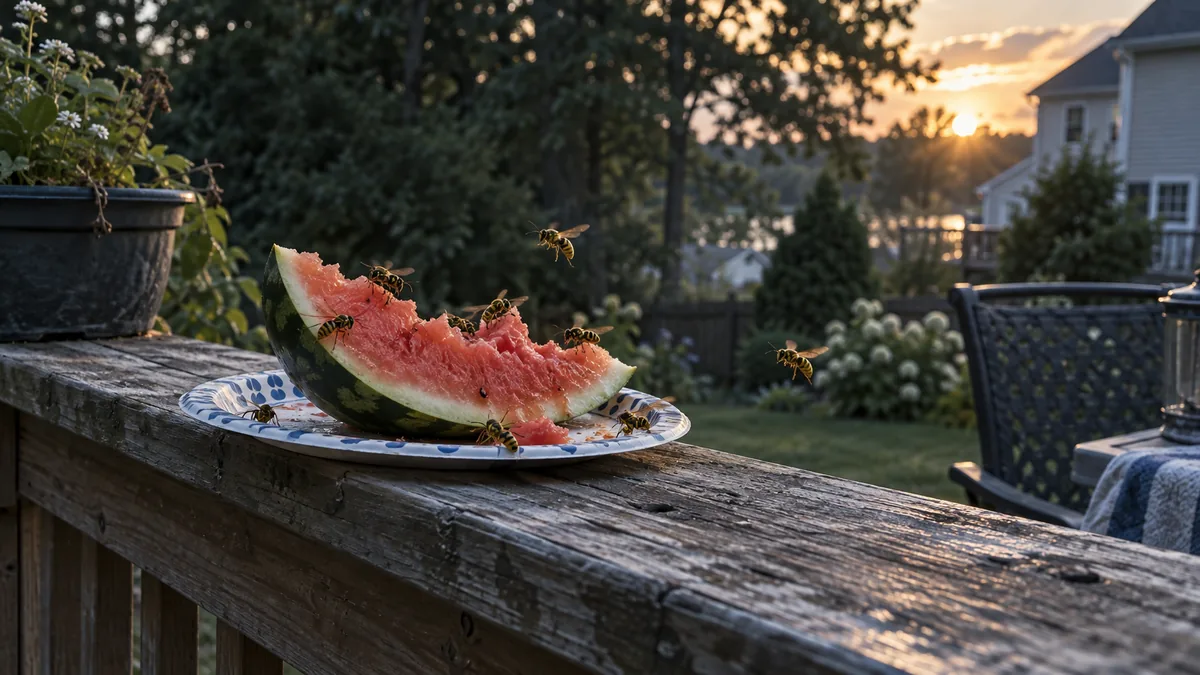
- Yellow jacket colonies grow all season and peak at 1,000-4,000 workers by late August in NJ
- In late summer the colony's diet shifts from protein to sugar, which is why they swarm drinks, fruit, and trash cans
- Most backyard stings come from disturbed ground nests you didn't know were there, mowing over one is the classic trigger
- Never pour gasoline or seal a nest opening; a professionally treated nest dies out, and colonies don't reuse nests next year
The Colony Clock Explains Everything
A yellow jacket colony in New Jersey starts every spring from a single overwintered queen. Through May and June the colony is small, a few dozen workers focused entirely on hunting insects to feed larvae. They have no interest in you or your lunch. That's the polite phase.
By August, that same colony holds one to four thousand workers. The queen slows egg-laying, the larvae that once demanded protein are mostly grown, and the workers' mission changes: instead of hunting caterpillars, they forage for sugar. Your soda, your fruit salad, your open trash can, the juice dripping from the grill, that's the new food supply. More wasps, less natural food, and a shifting diet is the exact recipe for the aggressive late-summer behavior everyone notices.
Where the Nests Actually Are
Most people picture the gray paper ball hanging off an eave, that's usually a bald-faced hornet nest. The yellow jackets stinging people in Monmouth County backyards are overwhelmingly nesting in places you can't see:
- In the ground, old rodent burrows, gaps under landscape timbers, holes at the base of shrubs. The classic "I got stung six times mowing the lawn" nest.
- In structures, wall voids, behind siding, under deck boards, in sheds. You'll see a steady traffic line of wasps entering and leaving one small gap.
- Under things, railroad ties, wood piles, dense ivy and ground cover.
The tell is traffic: stand back at a distance in the morning and watch for a consistent flight line into and out of one spot. That's the nest entrance.
What Not to Do (People Get Hurt Doing These)
Don't pour gasoline in a ground nest. It's dangerous, it's illegal to apply that way, and it poisons your soil.
Don't seal the entrance of a wall-void nest. Trapped yellow jackets chew through drywall and end up inside your house, hundreds of them.
Don't spray a can of hardware-store wasp killer into a large late-summer nest at midday. You'll kill the wasps at the entrance and enrage the rest. Late-season colonies defend hard, and yellow jackets can sting repeatedly.
If anyone in the household has had a serious sting reaction, treat every hidden nest as a professional job, full stop.
What Actually Works
Professional treatment targets the nest itself, applied at the entrance so returning foragers carry it into the colony, at the time of day when the colony is home. A treated nest collapses within a day or two, and here's the good news about yellow jacket biology: colonies die off naturally at first hard frost, queens overwinter elsewhere, and old nests are not reused. Solve the nest that's threatening your yard now and you are not signing up for an annual battle at that spot.
Between now and frost, reduce the attraction: keep trash cans lidded, don't leave drinks open and unattended, pick up fallen fruit, and rinse recycling. It won't remove a nest, but it cuts the traffic through the spaces your family uses.
The Short Version
Late-summer aggression is peak-colony biology, not bad luck. Find the flight line, don't DIY a hidden or ground nest, and call (732) 272-1929, we'll locate the nest, treat it properly, and give you your yard back for the best weeks of fall.