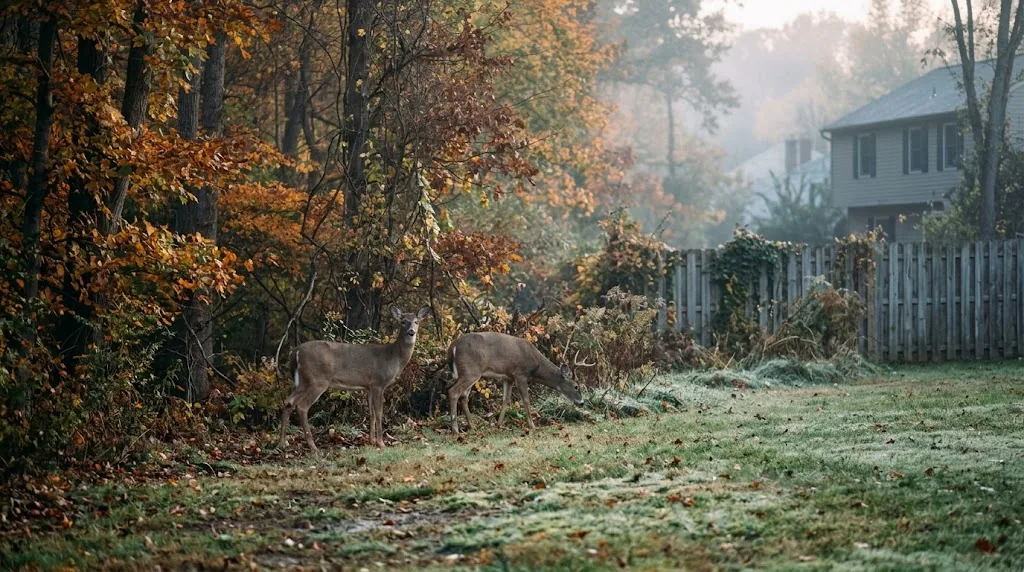
- Adult blacklegged ticks use deer as their primary mating and feeding host, which is why the species is called the deer tick
- A single deer can carry dozens to hundreds of adult ticks
- Deer movement spikes during the October and November rut, redistributing ticks onto properties that were quiet in summer
- Ticks drop off where deer linger, so your tick hot spots follow deer travel and browsing paths
- Fencing and plant choices change deer behavior, which changes where ticks land
Why Deer and Adult Ticks Are Linked
The blacklegged tick gets its common name honestly. Its larvae and nymphs feed mostly on small animals like mice, chipmunks and birds, but the adult stage depends heavily on large mammals, and in New Jersey that means white-tailed deer. Adults climb vegetation, wait, grab a passing deer, feed, and mate right there on the animal.
The numbers involved are larger than most people expect. Surveys of harvested deer routinely find dozens of adult ticks on a single animal, and heavily infested deer can carry into the hundreds. A fed female then drops off to lay somewhere on the ground, and a single female lays thousands of eggs.
So a deer walking through your yard is not just eating your hostas. It is a distribution system.
What the Rut Changes
From roughly mid-October through November, bucks are moving far more than usual and over much larger ranges, and does are moving to avoid them. Several things follow from that:
- Deer use routes they ignored all summer. A property that saw almost no deer in July can suddenly be on a travel corridor in late October.
- They move more during daylight, which is why you are seeing them now and did not before.
- More ground covered means wider tick distribution. Ticks picked up at a wood line two properties over can end up dropping in your beds.
This lines up exactly with the adult tick activity peak, which is why October is a worse tick month than most people believe.
Your Tick Hot Spots Follow the Deer
Ticks drop off where the deer slow down or stop. On a typical yard that means:
- The browse line, where ornamentals meet the lawn. Hostas, arborvitae, yews and daylilies are deer magnets, and they are usually planted right where people walk.
- Gaps in the fence or the wood line that funnel traffic through one spot.
- Bedding areas in tall grass, brush piles, or an unmaintained back corner.
- Under fruit trees, if you have anything dropping apples or pears.
If you want to know where to be careful on your own property, follow where you see deer standing still rather than where you see them crossing.
What Actually Reduces It
Being realistic, you are not going to eliminate deer in Monmouth County. You can change where they go and what they find when they get there.
- Fencing works but has to be serious. Deer clear four feet without much effort. An eight foot fence is the standard recommendation, and a shorter fence usually just reroutes them to a gap rather than stopping them.
- Change what is on the menu. Swapping the most heavily browsed ornamentals for plants deer avoid, things like boxwood, Russian sage, ornamental grasses, lavender and daffodils, removes the reason to stop in the first place.
- Clean up the lingering spots. Brush piles, the unmowed back corner, and fallen fruit all create reasons to stay put.
- Treat the transition zone. The lawn-to-woods edge is where both deer traffic and tick density concentrate. That edge, not the open lawn, is where perimeter treatment earns its money.
- Keep the lawn short near the wood line, and consider a dry mulch or gravel strip as a buffer. Ticks do not cross dry open ground well.
One Thing Not to Do
Do not feed them. Corn piles and feeders concentrate deer in one spot on your property for extended periods, which is the most efficient possible way to load that area with adult ticks. It also tends to be the spot closest to the house, since that is where people put the feeder. Supplemental feeding of deer is restricted in parts of New Jersey for disease reasons, and the tick math makes it a bad idea regardless.
The Short Version
Adult ticks ride deer, deer move more in the fall rut, and your tick hot spots sit wherever deer linger. You cannot keep them out of the county, but you can make your yard a less appealing place to stop and treat the edge where they bring ticks in. Call (732) 272-1929 and we will look at your property line with you.