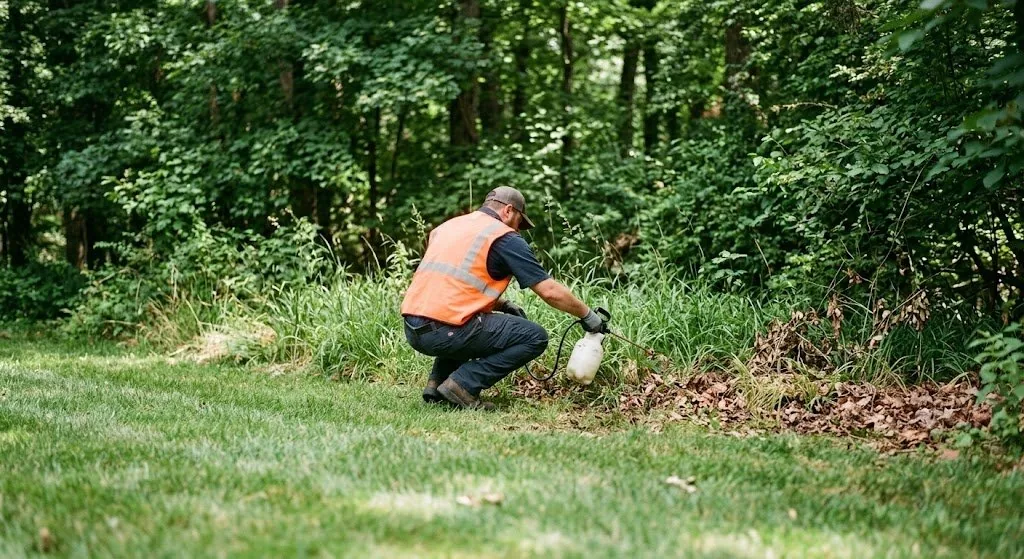
- One visit treats both pests, a mosquito barrier plus targeted tick application at the wood line
- Howell's wooded lots are prime tick habitat; the lawn-to-woods edge is the critical zone
- Products and placement are chosen to keep the treatment family- and pet-safe
- A mosquito treatment holds 21-30 days; tick applications last roughly 60
One Visit, Both Pests, Why We Treat Them Together
People tend to call about mosquitoes, because mosquitoes are the ones you notice. Ticks are quieter and, frankly, more dangerous. But on a property like this Howell lot, they overlap almost completely: mosquitoes rest in the shaded foliage and ticks wait in the tall grass and leaf litter, and both concentrate in the same shady back third of the yard. So rather than treat for one and leave the other, we knock down both in one visit. It's more effective and it saves the homeowner a second trip charge.
Howell's Wooded Lots Are Tick Country
Howell has a lot of properties like this one, bigger lots with a real tree line at the back, brushy borders, and shaded edges where the lawn meets the woods. That lawn-to-woods transition is the single highest-risk zone for ticks anywhere on a property, and in this part of New Jersey ticks carry real disease risk, including Lyme. Most homeowners have no idea how many ticks are sitting in the back twenty feet of their yard until someone goes looking. The wooded edge that makes a Howell backyard beautiful is exactly what makes it tick country.
What We Found on the Walk-Through
Before treating anything, we walked the property and read it the way the pests do. On this one that meant flagging:
- The lawn-to-woods transition along the back fence, thick with leaf litter and the prime tick zone
- Shaded mulch beds and dense shrubs near the patio where mosquitoes rest during the day
- Tall, damp grass at the property edges that never fully dries out
- A low, shaded corner holding water after rain, a mosquito breeding spot
- A woodpile and stone border that hold moisture and harbor both pests
That walk is what tells us where to concentrate the treatment instead of just spraying the open lawn, which is the one place neither pest actually hangs out.
The Combined Treatment
The backbone is a fine-mist barrier treatment driven into the foliage, the foundation line, the fence rows, and the shaded resting surfaces, that's what suppresses the mosquitoes. For the tick side, we focus the application low and at the edges: the tall grass, the leaf litter, and the lawn-to-woods line where ticks actually wait. Where we found standing water that couldn't be drained, we added a larvicide so the next generation of mosquitoes never hatches. One visit, both layers of the yard covered.
Keeping It Safe for the Family
This was a house with kids and a dog, so the first question was the right one: is it safe? The products are applied at label rate and are safe for family and pets once the treated surfaces have dried, usually about 30 minutes. We also work around pollinators, we treat resting and harborage zones, not flowering plants in bloom. After it dries, the family gets the yard back, the dog can run the fence line again, and the good bugs are left alone.
How Long It Holds, and the Season Schedule
A barrier treatment runs about 21 to 30 days on a typical Howell property, which is why we treat on a recurring schedule rather than once and done. The plan that keeps both pests down through the season looks like this:
- A first treatment to knock the current population back
- Follow-ups every three to four weeks from spring through October
- Tick-focused attention on the wooded edges at every visit
- Larvicide refreshed on any standing water that keeps coming back
- If heavy rain is coming within a day of a visit, we reschedule so it doesn't wash off
One treatment buys you the next month; the schedule is what gives you a backyard that stays usable all summer.
The Short Version
On a wooded Howell lot, mosquitoes and ticks share the same back yard, so it makes sense to treat them together: one walk-through to find where each pest lives, a barrier treatment for mosquitoes in the foliage, focused tick control in the grass-and-leaf-litter edges, larvicide on any standing water, and a recurring schedule to hold it through the season.
Owner Anthony Howard answers every call and walks every property himself. Free estimates throughout Howell and across Monmouth County, call (732) 272-1929.