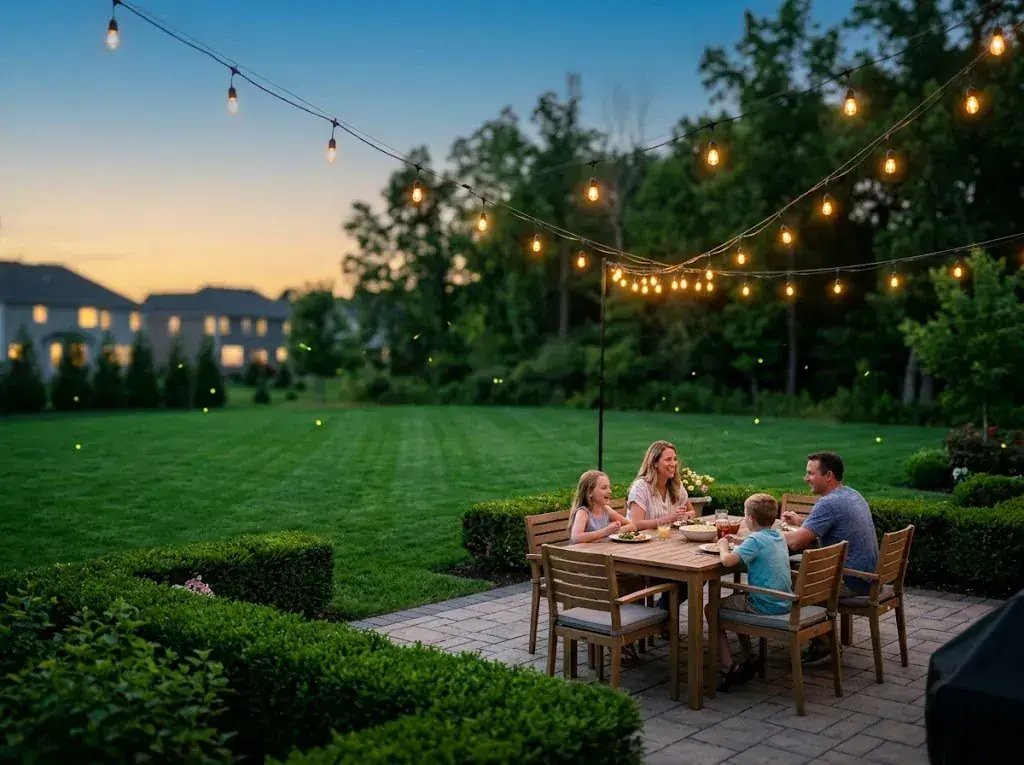
- Modern barrier treatments use EPA-registered products at low residential concentrations
- The main precaution is simple: stay off treated areas until dry, about 30 to 60 minutes
- Once the application dries, kids, dogs, and cats can use the yard normally
- Ask any provider what product they use and what the re-entry interval is, good companies answer directly
What's Actually in a Modern Barrier Treatment
Most professional mosquito barrier treatments use one of two active ingredient categories:
Synthetic pyrethroids
Lab-modified versions of pyrethrin, a natural insecticide produced by chrysanthemum flowers. The most common ones in residential treatments are bifenthrin, permethrin, and lambda-cyhalothrin. They:
- Disrupt nervous systems of insects on contact
- Bind to organic surfaces (leaves, mulch, fence posts) and remain active for 3-4 weeks
- Are essentially non-volatile once dried, they don't off-gas or drift indoors
- Break down into inactive compounds when exposed to UV light over time
- Have very low oral toxicity in mammals, humans and pets metabolize them quickly
Botanicals (essential oil based)
Treatments based on rosemary oil, geraniol, peppermint, cedarwood, or similar. They:
- Repel and kill mosquitoes through different mechanisms (irritation, scent disruption)
- Generally have shorter residual activity (10-14 days)
- Are USDA-approved for organic certification
- Are safe for direct contact in most cases
- Cost more per treatment because more product is needed for the same coverage
We offer both, and the right choice depends on the property and the family's preferences. Some customers want maximum efficacy and minimum frequency (synthetic). Some want the lowest possible chemical exposure regardless of efficacy tradeoff (botanical). Both work; they work differently.
The Safety Profile in Plain English
Synthetic pyrethroids, the honest version
The active ingredients are toxic to insects in tiny amounts. They're toxic to humans only in much, much larger amounts than what's used in residential applications. The actual concentration of active ingredient in a typical barrier treatment after application is around 0.1%, meaning a yard treatment is roughly 99.9% water and inert carriers.
Once the treatment dries (typically 30-60 minutes after application), the residue is bound to surfaces. It's not floating in the air. It doesn't transfer easily to skin. It only kills mosquitoes that land directly on treated surfaces.
That said, there are populations who should be more cautious:
- Cats: Particularly sensitive to permethrin. Reputable services don't use permethrin-based products on properties with outdoor cats, we use bifenthrin or botanical alternatives instead.
- Aquatic life: Pyrethroids are highly toxic to fish. Properties with ponds need careful application that avoids direct water contact.
- Bees and pollinators: We don't spray flowering plants, and we time treatments to avoid early morning (when bees are most active).
- People with chemical sensitivities: If anyone in the household has a known sensitivity, we recommend the botanical option.
Botanicals, what's misleading
"All natural" doesn't mean "100% safe." Concentrated essential oils can cause skin irritation in direct contact, and some are toxic to cats specifically (tea tree oil, peppermint, etc.). The professional-grade botanical formulations are diluted and tested, but the same precautions about wet residue still apply.
The toddler test
The standard precaution we give every family with kids: let the treatment dry, then your normal yard rules apply. We typically apply, dry within 30-60 minutes, and the yard is back to normal. We schedule treatments for times when kids and pets aren't immediately going outside, and we leave a written note on what was applied and when.
The Standard Precautions (And They're Actually Not Hard)
Day of treatment
- Kids and pets stay inside while we're applying (we're typically on-site for 30-60 minutes)
- Wait until the treatment is fully dry before letting anyone back outside (we'll tell you when it's safe)
- Bring in any pet food/water bowls that were outside during application
- Cover or remove kids' toys, sandboxes, etc. before we arrive, we'll do this if you ask, but homeowners usually prefer to handle items they care about
After treatment dries
- Normal yard activity is fine, kids playing, pets running around, gardening
- Don't have kids or pets dig in mulch beds for 24 hours (mulch holds residue longer than turf)
- Wait 1-2 hours before letting pets drink standing water that was treated (rare situation)
If it rains
- Treatment is essentially "set" 1-2 hours after application
- Light rain after dry time doesn't significantly reduce effectiveness
- Heavy storms within 24 hours can wash off treatment, we'll re-treat at no charge
What We Don't Do
This is as important as what we do:
- We don't apply on windy days. Drift is unpredictable and unsafe for neighbors.
- We don't treat flowering plants when bees are active. Period.
- We don't treat vegetables you eat. Tomato plants, garden beds, we work around these.
- We don't treat directly into water sources. Birdbaths, ponds, pool surrounds get worked around carefully.
- We don't oversell. If a property doesn't need treatment, we'll tell you. Some yards have low enough mosquito pressure that property modification (drainage fixes, vegetation trimming) is more effective than spraying.
How We Approach Family Safety
Our standard practice on every property:
- Anthony walks every property before treatment, identifies sensitive areas (kids' play zones, pet areas, ponds, gardens)
- We mark the boundaries of what's getting treated and what's getting avoided on the first visit
- You get a notification before we arrive so kids/pets can be inside
- You get a written summary after treatment of what was applied, where, and the safe-to-use-yard time
- If any treated area appears to cause an issue with your pet or family, we'll come out and re-evaluate immediately
The Math on Risk vs Reward
It's worth thinking about treatment in terms of what you're trading off:
The risks of treatment
- Minimal exposure during/right after application (mitigated by drying time)
- Possible localized impact on non-target insects (mitigated by application method)
- Cost
The risks of no treatment
- Mosquito-borne disease, West Nile, EEE, increasingly Dengue and others
- Tick-borne disease, Lyme, anaplasmosis, alpha-gal, others
- Unable to use your own yard during peak season
- DEET/repellent on kids and pets at higher daily doses than required if no barrier
- Sleep disruption from indoor mosquitoes that snuck in
For most NJ families, the risk math favors treatment. The peace of mind alone, kids playing in the yard without a constant repellent regimen, dinner on the deck without bites, dog walks at dusk without ticks, is what most customers come back to us for season after season.
What to Ask Any Mosquito Service
If you're getting quotes from us or anyone else, here are the questions worth asking:
- What active ingredient(s) do you use, and what's the concentration after application?
- Do you offer a botanical option?
- How do you handle properties with pets, kids, or sensitive plants?
- What's your re-treatment policy if it rains?
- Are you licensed for pesticide application in NJ? (We are, and you should never let an unlicensed applicator near your property.)
Anthony is happy to answer any of these. Call (732) 272-1929 for a free property walkthrough.