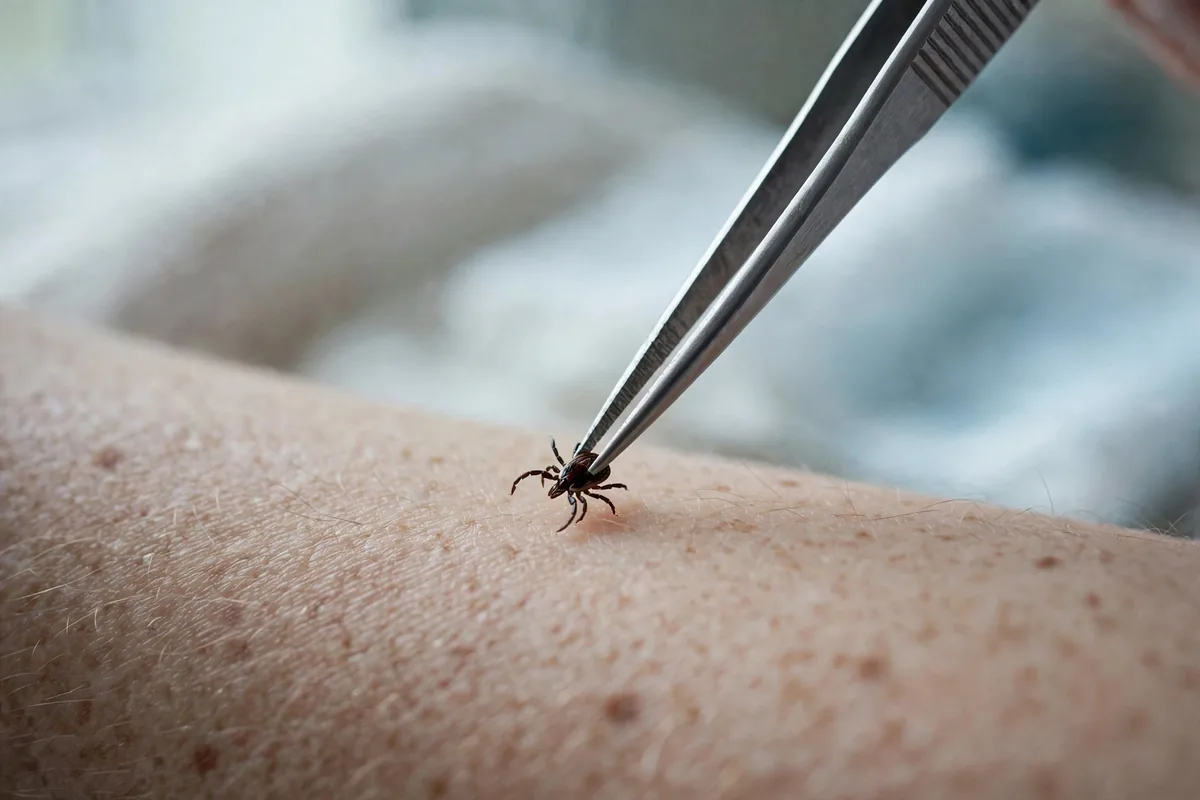
- Use fine-tipped tweezers, grip as close to the skin as possible, and pull straight up with steady pressure
- Do not twist, jerk, burn, smother, or paint the tick with anything
- Petroleum jelly, nail polish, and matches make the tick more likely to regurgitate into the bite
- Transmission risk for Lyme rises sharply after roughly 36 to 48 hours of attachment, so speed matters more than technique perfection
- Save the tick, note the date, and watch the site for 30 days
The Correct Method, Start to Finish
You need one tool: fine-tipped tweezers. Not the flat, blunt-ended pair in a drugstore manicure kit, those crush the tick's body. Pointed tweezers or a dedicated tick removal tool.
- Grip as close to the skin as you can get. You are aiming for the tick's mouthparts where they enter the skin, not the fat body at the back. Gripping the body is what squeezes its stomach contents into the bite.
- Pull straight up, slow and steady. Even pressure. It may take several seconds of firm tension before it releases. That is normal. The urge to yank is the thing to resist.
- Do not twist or wiggle. A blacklegged tick's mouthpart is barbed, not threaded. Twisting does not unscrew it, it snaps it off.
- Clean the bite and your hands with rubbing alcohol or soap and water.
- Dispose of it properly. Alcohol in a sealed container, or tape it to an index card. Do not crush it with your fingers.
If a bit of mouthpart stays behind, leave it alone. Clean the area and let the skin push it out the way it would a splinter. Digging at it with a needle causes far more irritation and infection risk than the fragment does.
The Methods That Make It Worse
Every one of these is still circulating, and every one of them is counterproductive:
- Petroleum jelly or nail polish to "suffocate" it. Ticks breathe extremely slowly. Long before it suffocates, a stressed tick can regurgitate into the wound, which is exactly the transmission event you are trying to prevent. Meanwhile it stays attached for hours longer while you wait for a result that is not coming.
- A hot match or cigarette. Same problem, plus you are now holding fire against skin. This one shows up in old scouting manuals and should have died there.
- Dish soap on a cotton ball. Occasionally a tick lets go. Usually it does not, and you have lost time.
- Twisting counterclockwise. There is no thread. There is a barb.
The theme is consistent: anything that irritates a tick while it is still attached increases the chance it pushes fluid back into the bite. Mechanical removal, fast, is the entire strategy.
How Long It Was Attached Matters More Than Anything
This is the part worth internalizing, because it reframes the whole thing. For Lyme disease, the blacklegged tick generally needs to be attached for roughly 36 to 48 hours before transmission becomes likely. Under 24 hours, the risk is low. That is why a daily tick check is a more powerful intervention than perfect removal technique.
Two caveats. First, other pathogens do not follow the same clock. Some can transmit considerably faster, which is why "it was only on a few hours" is reassurance, not a guarantee. Second, a nymph the size of a poppy seed can be attached for two days before anybody notices, which is precisely why nymphs cause most Lyme cases.
If you cannot tell how long it was on, assume longer rather than shorter.
After the Removal
- Write down the date and where on the body. If you develop symptoms weeks later, that note is genuinely useful to a doctor.
- Keep the tick. Tape it to a card or drop it in a small bag. Identifying the species matters, since a dog tick and a blacklegged tick carry different risks.
- Watch the site for about 30 days. The expanding rash people associate with Lyme appears in many but not all cases, and it does not always look like a clean bullseye. A small red bump right at the bite in the first day or two is usually just irritation, not infection.
- Call a doctor if you see an expanding rash, or develop fever, chills, fatigue, headache, or joint aches in the weeks after. Mention the bite and the date.
For Dogs
Same technique, same tools. The difficulty is finding them under fur. Check ears and inside the ear flap, the neck and collar line, between the toes, the armpits, and around the tail. Run your hands over the whole dog after any walk near a wood line. Talk to your vet about year-round preventive coverage rather than seasonal, since adult ticks are active well into the cold months.
The Short Version
Fine tweezers, close to the skin, straight up, no twisting. Skip every folk remedy. Check daily, because catching it early beats removing it perfectly. If ticks keep turning up on your family or your dog, the yard is the actual problem, and that is fixable. Call (732) 272-1929 and we will take a look.