- Mosquitoes stay active in NJ until temperatures hold consistently below about 50 degrees, typically mid-to-late October
- Shore towns run one to three weeks later than inland Monmouth County because the ocean moderates temperatures
- Ticks are the stronger argument for fall treatment, since adults peak exactly when people stop
- A light frost doesn't end mosquito season, a sustained hard freeze does
- If you're mostly indoors by September and have no wood line, stopping is a defensible call
What Actually Ends Mosquito Season
Not the calendar, and not one cold night. Mosquito activity winds down when temperatures hold consistently below roughly 50 degrees. Below that, they stop flying and feeding in any meaningful way. Above it, they're back, even in late October.
A light frost is not the finish line people assume it is. It knocks back the exposed adults, but a warm stretch afterward pulls more out of sheltered spots, and in New Jersey warm stretches in October are routine. What genuinely ends it is a sustained hard freeze.
In practice, inland Monmouth County, places like Freehold, Colts Neck, Manalapan, tends to go quiet somewhere in mid-to-late October. The shore runs later.
Why the Shore Runs Later
Water holds heat longer than land does. Through the fall, the ocean is warmer than the air, and that moderates overnight lows in the towns closest to it. Long Branch, Monmouth Beach, Sea Bright, Oceanport, Deal, and West Long Branch routinely stay a few degrees above inland towns on the nights that matter.
A few degrees sounds trivial. It isn't. It's often the difference between a night below the activity threshold and a night above it, and across several weeks that compounds into one to three extra weeks of mosquito activity for coastal properties compared to properties fifteen minutes inland.
The Stronger Argument Is Ticks
If mosquitoes were the only consideration, stopping in late September would be reasonable for a lot of properties. Ticks change the math.
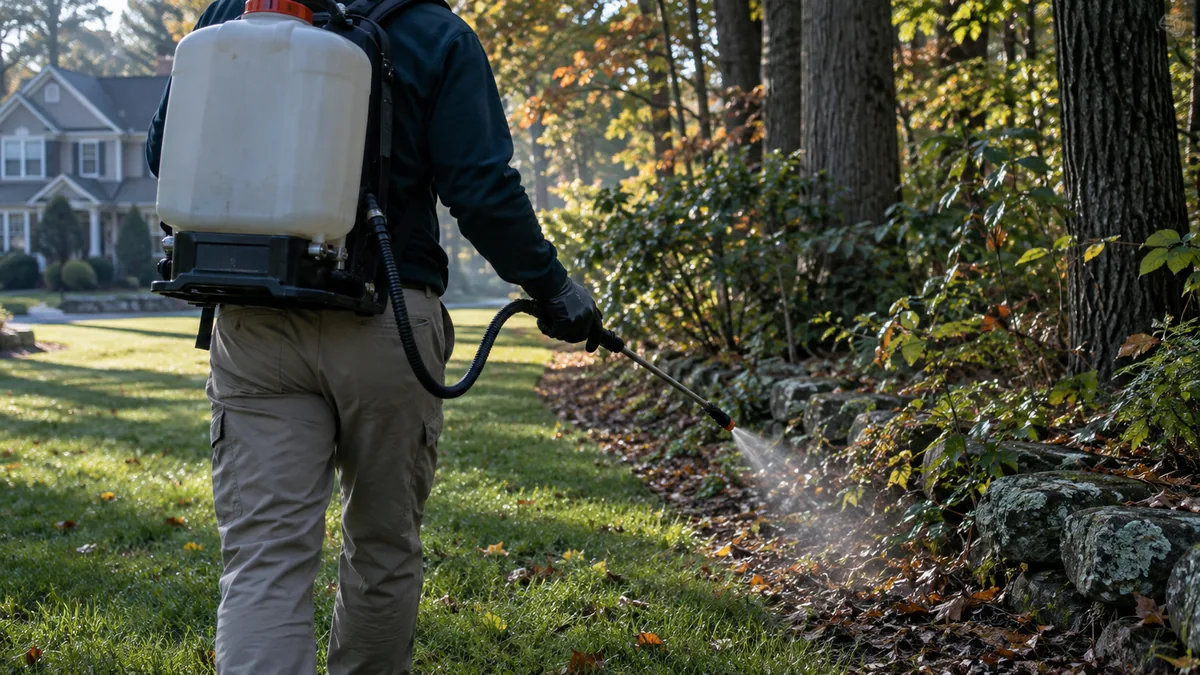
Adult blacklegged ticks surge in October and November, they carry Lyme at higher rates than the summer nymphs, and they stay active any day above about 40 degrees. The fall tick treatment is the one that covers a real, measurable risk window that most homeowners leave completely uncovered. If you have a wood line, leaf litter, a dog, or kids who play at the edge of the yard, this is the treatment we'd argue hardest for.
What a Late-Season Treatment Actually Does
Two things worth understanding, because they're different from a midsummer application:
- It knocks down the fall adult population during the weeks when West Nile-carrying Culex mosquitoes are at their seasonal peak infection rate, and when adult ticks are surging.
- It reduces the population heading into shelter. Mosquitoes that survive to late fall are the ones seeking out protected spots to overwinter. Fewer of them going in means a smaller starting population next spring.
Our Full Season package runs eight treatments April through September for exactly this reason. The Summer Special, five treatments May through August, deliberately ends earlier, which is why we'll often suggest adding a fall tick application to it rather than leaving September and October bare.
When Stopping Is Genuinely Fine
We'd rather tell you this than not. Stopping after Labor Day is a defensible call if most of these describe you:
- You're inland, not coastal
- Your yard is open lawn with no wood line, heavy shrubs, or leaf-holding beds
- Nobody in the household is outdoors much at dusk once school starts
- You don't have a dog moving between the yard and the house
- Nobody in the home is over 60 or immunocompromised
If that's your property, the marginal value of another treatment is genuinely small, and we'll say so.
The Short Version
For most Monmouth County properties, and nearly all coastal ones, treatment through September and into October earns its keep, mostly on the strength of the tick argument. For an open inland lot with nobody outside after dark, stopping is fine. If you want a straight read on which one you are, call (732) 272-1929. Anthony answers.