- Droppings are the fastest ID: mouse droppings are rice-sized, rat droppings are two to four times larger
- Mice explore openly and nest indoors; rats are cautious and often travel in from outside burrows
- Mice fit through a dime-sized gap; rats need about a quarter
- Treatment differs by species, a correct ID first prevents wasted bait and traps
You Heard Something Last Night
Scratching in the ceiling at 2 AM. Gnawing sounds behind the kitchen wall. Droppings in the pantry cabinet. Something is in your house, and you need to know what before you know how to deal with it.
In Monmouth County, the two most common rodent intruders are the house mouse (Mus musculus) and the Norway rat (Rattus norvegicus). They're related but they're different animals with different behaviors, different entry points, and different control strategies. Treating a rat problem with mouse tactics, or vice versa, wastes time and money.
Size and Droppings, The Quickest ID
Mouse droppings are small, about 1/4 inch, roughly the size and shape of a grain of rice, dark brown, pointed on both ends. Mice produce 50-75 droppings per day, so if you have mice, you'll find droppings everywhere they travel, along walls, in cabinet corners, in drawers, under appliances.
Rat droppings are significantly larger, 1/2 to 3/4 inch, capsule-shaped with blunt ends, dark brown to black. Rats produce fewer droppings per day (40-50), but each one is distinctly bigger than a mouse dropping. If you're finding droppings that are clearly larger than rice, you have rats.
Behavior Differences
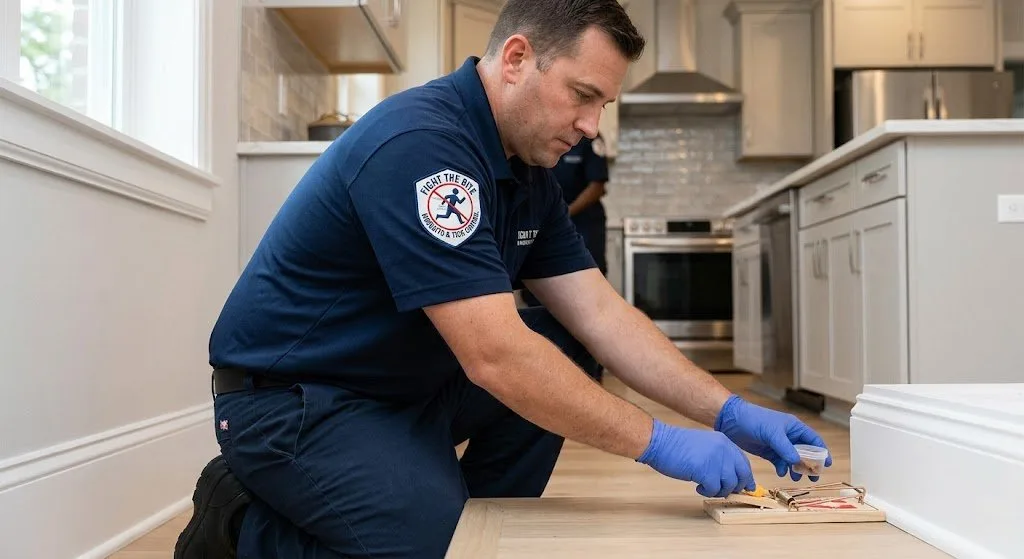
Mice are curious. They explore new objects in their environment, which makes trapping relatively easy. A new trap placed along a mouse travel route will often get a catch within 24-48 hours. Mice travel close to walls and edges, leaving grease rub marks along baseboards.
Rats are cautious. They're neophobic, afraid of new things. A new trap placed in a rat's path may be avoided for days or weeks. Rats need to grow accustomed to the trap's presence before they'll interact with it. This is why snap traps need to be placed unset for several days in rat-active areas before being armed and baited.
Mice are primarily indoor nesters, they'll live their entire lives inside your house. Rats (Norway rats) typically nest outdoors in burrows and enter structures to feed. You may have rats inside at night that live outside during the day. This means rat control requires both interior and exterior treatment.
Entry Points
Mice can squeeze through a gap the diameter of a dime, roughly 1/4 inch. Common entry points: gaps around pipe penetrations, spaces under doors, gaps where siding meets the foundation, utility line entries, and dryer vent hoods that don't seal tightly.
Rats need a slightly larger gap, about the size of a quarter (1/2 inch), but they're stronger and can gnaw through materials mice can't, including plastic pipe, soft metals like aluminum, and cured concrete. Rat entry points include damaged sewer lines (rats are excellent swimmers and can enter through broken pipes), gaps in foundation walls, unscreened crawl space vents, and burrows that tunnel directly under foundations.
Why It Matters for Treatment
Mouse control focuses on interior trapping and exclusion, sealing every gap larger than 1/4 inch with steel wool, copper mesh, or hardware cloth. Bait stations are secondary.
Rat control is a wider operation, exterior burrow treatment, interior trapping with the neophobia factor accounted for, exclusion of larger gaps, and often involves addressing the outdoor conditions (compost piles, bird feeders, wood piles) that attracted rats to the property in the first place.
Using mouse-sized traps for rats catches nothing. Using rat-sized traps for mice sometimes works but isn't optimized. And bait placement, bait type, and station location all differ between the two species.
Get It Identified
Send Anthony a photo of the droppings, or describe what you're hearing and where. He'll tell you over the phone what you're likely dealing with and schedule a free inspection to confirm. Call (732) 272-1929.