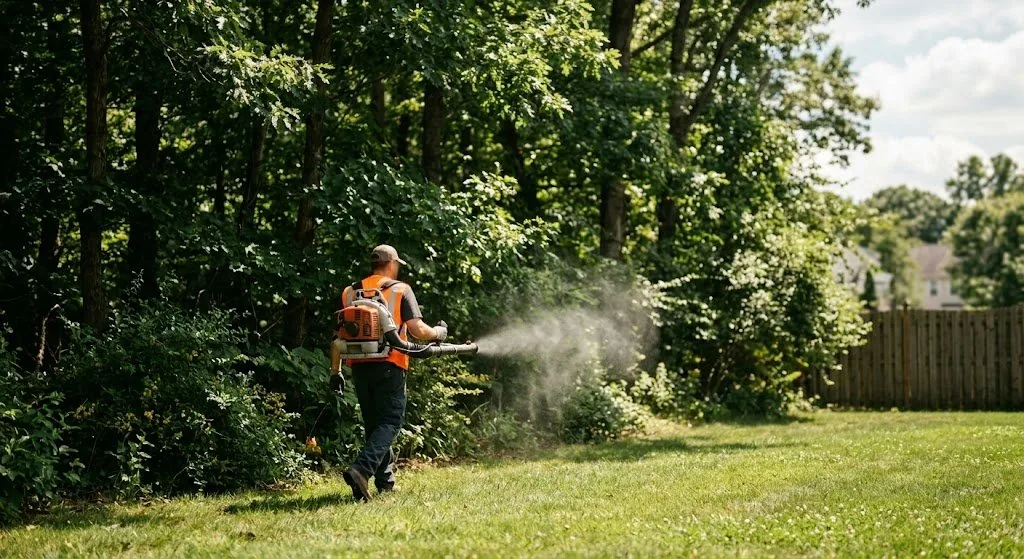
- Wooded lot lines and dense vegetation make Howell yards high-pressure mosquito territory
- We walk the property first to find breeding sites before applying the barrier treatment
- One treatment holds roughly 21-30 days; seasonal plans space visits every 3-4 weeks
- Dumping standing water between visits meaningfully extends results
Why Howell Backyards Get Hit So Hard
Howell is one of the more mosquito-prone towns we treat in Monmouth County, and the reason is geography. Large lots, mature tree lines, wooded back edges, and plenty of low spots that hold water after a storm, that is a mosquito factory. Add the wetland pockets and retention basins scattered through the township and you have standing water within flying range of most properties whether you can see it or not.
The homeowner does not have to have a pond to have a problem. A clogged gutter, a tarp with a fold in it, a kid's wagon left out, a corrugated drain pipe holding two inches of water, any of those produces hundreds of mosquitoes on a one-to-two week cycle. By the time you are getting bitten on your own patio, several breeding cycles have already happened.
We Walk the Property Before We Spray
The treatment does not start with the sprayer. It starts with Anthony walking the entire property and reading it the way the mosquitoes do. On this Howell job that meant checking the obvious places and the ones homeowners never think about:
- The wooded back edge where adult mosquitoes rest during the heat of the day, on the undersides of leaves and in the shaded brush
- Gutters and downspout splash zones holding water and organic debris
- Low, shaded mulch beds along the foundation, a favorite daytime resting spot
- Anything holding standing water, drain outlets, plant saucers, a birdbath, a recycling bin left uncovered
- Dense shrubs and ornamental plantings near the patio and play area
Identifying the resting and breeding zones is what makes the actual spraying effective. A technician who just walks the perimeter blasting the lawn is wasting product on the one part of the yard mosquitoes do not hang out in.
The Barrier Treatment Itself
Once the property is mapped, we apply a barrier treatment using a backpack mist blower that pushes a fine droplet into the foliage, not a garden-hose stream that runs off the leaf. That mist coats the undersides of leaves, the lower branches, the shaded resting surfaces, the fence lines, and the foundation band where mosquitoes land. When a mosquito rests on a treated surface, it picks up the active ingredient and dies. The barrier keeps working as new adults emerge from any breeding sites nearby and land on your yard.
Where we find standing water that cannot be drained, a drainage swale, a French drain outlet, a low corner that stays wet, we add a larvicide that kills mosquito larvae before they ever become biting adults. Knocking out the next generation is just as important as killing the current one.
How Long One Treatment Holds
A quality barrier treatment gives roughly 21 to 30 days of control on a typical Howell property. That is why we treat on a recurring schedule through the season rather than as a one-off:
- A first barrier treatment to knock the population down
- Follow-up treatments every three to four weeks from spring through October
- Larvicide on any standing-water sources we identified on the walk-through
- If rain is forecast within 24 hours of a scheduled visit, we reschedule, a treatment washed off an hour after it goes down is wasted money
One treatment buys you the rest of that month. The schedule is what gives you a summer where the backyard is actually usable at dusk.
Is It Safe Around Kids and Pets?
This is the first question almost every Howell parent asks, and it is the right one. The products we use are applied at label rate and are safe for family and pets once the treated surfaces have dried, usually about 30 minutes. We tell homeowners to keep kids and dogs off the treated areas until then, and after that the yard is back to normal. We are not fogging the air; we are coating surfaces mosquitoes rest on.
What You Can Do Between Treatments
The treatment does the heavy lifting, but a few habits keep your Howell yard from rebuilding a population between visits:
- Dump standing water weekly, plant saucers, buckets, toys, tarps, wheelbarrows. A bottle cap of water is enough to breed mosquitoes.
- Keep gutters clean so they drain instead of holding debris-filled water.
- Refresh birdbaths and pet bowls every few days.
- Cut back dense, shaded vegetation near the patio to reduce daytime resting spots.
- Fix low spots and drainage that stay wet long after rain.
None of it replaces the barrier treatment, but it removes the breeding sites the treatment cannot reach.
The Short Version
A real mosquito spraying in Howell is not someone showing up and hosing your lawn. It is a property walk-through to find where the mosquitoes actually live, a fine-mist barrier treatment on the resting and harborage zones, larvicide on standing water, and a recurring schedule that keeps the barrier intact through the season.
Owner Anthony Howard answers every call personally and walks every property himself. Free estimates anywhere in Howell and across Monmouth County, call (732) 272-1929.