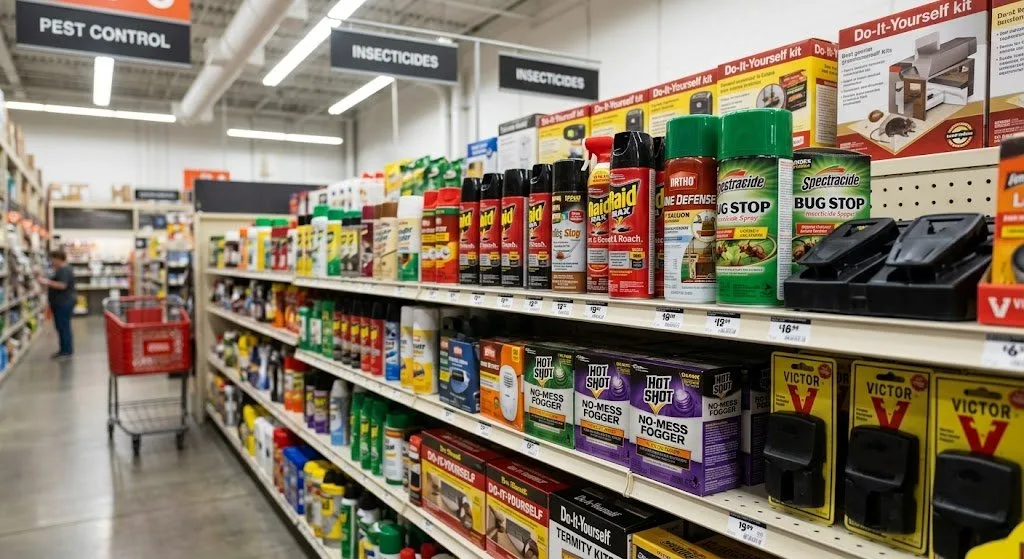
- Store products can handle small, early, accessible problems, DIY fails on established or hidden infestations
- Most DIY failures come from treating what you can see instead of the source
- Misapplied products waste money and can scatter pests deeper into the structure, especially bed bugs and ants
- Try DIY once on minor issues; call a pro when it persists or involves termites, bed bugs, or rodents
The Aisle 12 Dilemma
You see a few ants in the kitchen. Do you call a pest control company, or do you spend $8 on a can of Raid and handle it yourself? For a few ants, the $8 can is probably fine. For a carpenter ant colony in your wall framing, the $8 can is going to cost you $8 plus however much it costs to fix the structural damage that accumulated while you thought you'd solved the problem.
The line between DIY-appropriate and professional-necessary isn't always obvious. Here's how to tell where your situation falls.
When DIY Works
Occasional invaders. A few ants trailing in from outside, the odd spider, a stink bug on the curtain, a cricket in the garage. These are normal environmental encounters, not infestations. A perimeter spray around doors and windows, sealing entry points, and good sanitation handle the vast majority of occasional invaders.
Preventive treatment. Applying granular insect killer around your foundation in spring, keeping vegetation trimmed away from the house, fixing moisture issues, sealing cracks, these maintenance tasks don't require a professional and they genuinely reduce pest pressure.
Single mouse. A snap trap with peanut butter along a wall in the kitchen will catch a single mouse quickly. If you catch one and don't catch another within a few days, you probably had a lone intruder.
When DIY Fails
You're treating what you can see, not what you can't. The #1 reason DIY pest control fails is that visible pests are the tip of the iceberg. You spray the ants on the counter but the colony of 10,000 is in the wall void behind the dishwasher. You kill the mouse you saw but there are 15 more you didn't. Consumer products treat surfaces; professional treatments address the source.
Bug bombs (foggers) make things worse. Total release foggers are the most commonly misused pest control product. They disperse insecticide into the air of a room. The problem: the pesticide settles on top of surfaces. Pests hide underneath and inside things, inside wall voids, behind baseboards, under appliances, inside electronics. Foggers don't reach these areas. Worse, the repellent effect of the settled pesticide can scatter cockroaches, bed bugs, and ants deeper into walls and adjacent rooms, spreading the infestation.
Incorrect identification. You think you have pavement ants (harmless nuisance) but you actually have carpenter ants (wood-destroying). You think you have drain flies (cosmetic) but you have fungus gnats (indicates moisture problem). You think you have termites but you have carpenter ants, or vice versa. Treatment for the wrong pest wastes money and time while the real problem continues.
Resistance and tolerance. Cockroaches, especially German cockroaches, have developed resistance to many consumer-grade pyrethroids. The spray that killed them in 2005 doesn't kill them in 2026. Professional-grade products use different active ingredients and application methods that consumer products can't match.
The Hidden Cost of "Saving Money"
A $200 professional treatment that solves the problem in one visit costs less than $40/month in DIY products over six months that don't solve it, plus the damage that accumulates while you're trying. Carpenter ant damage, termite damage, contaminated food from rodent droppings, health risks from cockroach allergens, the cost of delayed professional treatment almost always exceeds the cost of calling someone right away.
The Honest Answer
If you see one or two bugs occasionally, handle it yourself. If you're seeing pests regularly, in multiple locations, or finding evidence of nesting (droppings, damage, egg cases, mud tubes), call a professional. The free inspection costs you nothing and tells you exactly where you stand.
Call (732) 272-1929. Anthony will tell you straight, whether you need professional treatment or whether the $8 can of spray is actually the right call.